

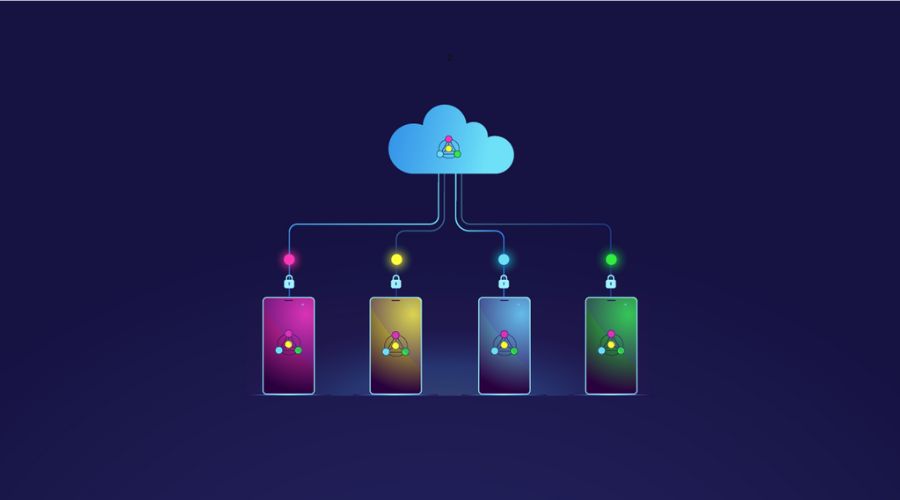
In an era where data privacy is a growing concern, artificial intelligence (AI) continues to evolve, offering innovative solutions that balance technological advancement with user autonomy. Federated Learning (FL) is one such breakthrough, redefining how AI models are trained while keeping sensitive data securely on users’ devices. Unlike traditional centralized approaches that require uploading personal data to a server, Federated Learning flips the script, bringing computation to the data rather than the other way around. This blog dives into the mechanics, benefits, and future potential of Federated Learning, exploring why it’s a game-changer for privacy-focused AI.
What is Federated Learning?
Federated Learning is a decentralized machine learning paradigm introduced by Google in 2016. It allows AI models to be trained across multiple devices—like smartphones, laptops, or IoT gadgets—without ever transferring raw user data to a central server. Instead, the devices themselves perform local computations and send only model updates (such as gradients or weights) to a central system, which aggregates these contributions to improve the global model.
How It Works
The process begins with a central server distributing an initial AI model to participating devices. Each device then trains this model using its local data—say, your typing habits on a smartphone keyboard or your fitness tracker’s step count. After training, the device sends back an update summarizing what it learned, not the data itself. The server aggregates these updates from thousands or millions of devices, refines the global model, and redistributes the improved version. This cycle repeats, enhancing the model iteratively while keeping your data where it belongs: on your device.
Centralized vs. Federated: The Privacy Edge
In traditional centralized learning, all data is collected and processed on a single server, raising risks of breaches, misuse, or unauthorized access. Federated Learning eliminates this by design. Since raw data never leaves your device, the attack surface shrinks significantly. Even if the server is compromised, attackers can’t access your personal information—only abstract model updates, which are meaningless without context.
Benefits of Federated Learning
Federated Learning isn’t just about privacy; it’s a versatile framework with far-reaching advantages for users, developers, and industries alike.
Enhanced Privacy and Security
The most obvious perk is its privacy-first approach. Whether it’s medical records, financial transactions, or personal messages, sensitive data stays local. This aligns with regulations like GDPR and HIPAA, which prioritize user consent and data protection. Moreover, encryption techniques often accompany FL, scrambling model updates to further thwart interception.
Reduced Bandwidth and Latency
Sending small model updates instead of bulky datasets cuts down on bandwidth usage. For users on limited data plans or in remote areas, this is a boon. It also speeds up the process, as devices don’t need to upload gigabytes of information—just kilobytes of refined insights.
Personalized AI Models
Because training happens locally, Federated Learning can tailor models to individual preferences without compromising privacy. Think of a virtual assistant that learns your speech patterns or a fitness app that adapts to your workout routine—all without sending your voice clips or step logs to the cloud.
Scalability Across Devices
With billions of devices worldwide, FL taps into a massive, distributed computational network. This scalability makes it ideal for applications like predictive text, autonomous vehicles, or smart healthcare, where diverse, real-time data is key.
Challenges in Federated Learning
Despite its promise, Federated Learning isn’t without hurdles. Implementing it effectively requires overcoming technical and practical obstacles.
Device Heterogeneity
Not all devices are created equal. A high-end smartphone and a basic IoT sensor differ vastly in processing power, storage, and battery life. Coordinating training across such varied hardware—known as system heterogeneity—can complicate FL deployments.
Data Variability
Local datasets aren’t uniform either. Your phone might have thousands of photos, while mine has a handful of texts. This non-IID (non-independent and identically distributed) data can skew model updates, making aggregation trickier and potentially reducing accuracy.
Communication Overhead
While FL reduces data transfer, frequent communication between devices and the server can still strain networks, especially if millions of devices are involved. Optimizing this exchange—through compression or selective updates—is an ongoing research focus.
Security Risks Beyond Privacy
Though raw data stays local, FL isn’t immune to attacks. Malicious actors could tamper with model updates (a “poisoning attack”) or reverse-engineer them to infer private details. Robust defenses, like anomaly detection and secure aggregation, are critical to mitigate these risks.
The Future of Federated Learning
Federated Learning is still in its adolescence, but its trajectory is promising. As privacy concerns mount and computing power grows, FL could become the default for AI training in many domains.
Healthcare Revolution
Imagine hospitals collaborating on a disease prediction model without sharing patient records. Federated Learning enables this, pooling insights from diverse populations while complying with strict privacy laws. Projects like Google’s work on diabetic retinopathy detection showcase this potential.
Smarter Edge Devices
Edge computing—processing data on devices like smartwatches or home assistants—pairs naturally with FL. As 5G and next-gen hardware roll out, expect more responsive, privacy-preserving AI at your fingertips, from real-time language translation to adaptive energy management.
Cross-Industry Collaboration
Companies could use FL to share knowledge without exposing trade secrets. For instance, automakers might refine self-driving algorithms collectively, each contributing insights from their fleets, all while keeping proprietary data under wraps.
Democratizing AI
By leveraging everyday devices, FL lowers the barrier to AI development. Small startups or research groups without massive server farms can still build powerful models, fostering innovation and reducing reliance on tech giants.
Conclusion
Federated Learning represents a paradigm shift in AI—one where privacy, efficiency, and scalability coexist. By keeping data on your device, it empowers users to benefit from cutting-edge technology without sacrificing control. While challenges like device diversity and security remain, ongoing advancements are steadily ironing them out. From healthcare to smart homes, Federated Learning is poised to shape a future where AI is not only intelligent but also respectful of boundaries. As we move deeper into 2025, this privacy-focused approach could well become the backbone of a more ethical, user-centric digital world.
For more information, visit Vatysya.
FAQs
[su_accordion]
[su_spoiler title=”How does Federated Learning differ from traditional machine learning?” open=”no” style=”default” icon=”plus” anchor=”” anchor_in_url=”no” class=””]Traditional machine learning centralizes data on a server for training, while Federated Learning trains models locally on users’ devices and aggregates only the updates. This keeps raw data private and reduces the need for large-scale data transfers.[/su_spoiler]
[su_spoiler title=”Is Federated Learning completely secure?” open=”no” style=”default” icon=”plus” anchor=”” anchor_in_url=”no” class=””]While it enhances privacy by keeping data local, it’s not foolproof. Threats like model poisoning or inference attacks exist, but techniques like encryption and secure aggregation help mitigate these risks.[/su_spoiler]
[su_spoiler title=”What are some real-world examples of Federated Learning?” open=”no” style=”default” icon=”plus” anchor=”” anchor_in_url=”no” class=””]Google uses FL for Gboard’s predictive text, improving suggestions without uploading your typing data. It’s also being explored in healthcare for collaborative disease modeling and in automotive for refining autonomous driving systems.[/su_spoiler]
[/su_accordion]

